Property Communication Task Center
DANGER: KEEP OUT 🛡️ 2026 OSHA/FHA Compliant
Establish a legally defensible physical exclusion zone, warn unauthorized personnel (especially children) of heavy machinery and trenching hazards, and mitigate "Attractive Nuisance" and trespasser liability.
Not just a template.
A reality execution tool.
Don't risk tenant disputes with messy Word docs. Generate a print-ready, OSHA-compliant physical notice in exactly 30 seconds.
- 1Bilingual Architecture English & Spanish integrated into a single US Letter design. Crucial for legal compliance in 14+ states.
- 2Toner-Friendly Print Engineered for black-and-white office printers. High contrast hierarchy ensures readability from 10 feet away.
- 3Locked Formatting Zero layout breakage. Type your details, and the engine physicalizes it without overflowing the page.
DANGER: KEEP OUT
PELIGRO: NO PASAR
Why use this template?
- ✓ Bilingual output (English/Spanish) prevents FHA liability
- ✓ Formatted strictly for US Letter B&W physical printing
- ✓ Zero JS bloat, generates instantly in your browser
Print Output Preview
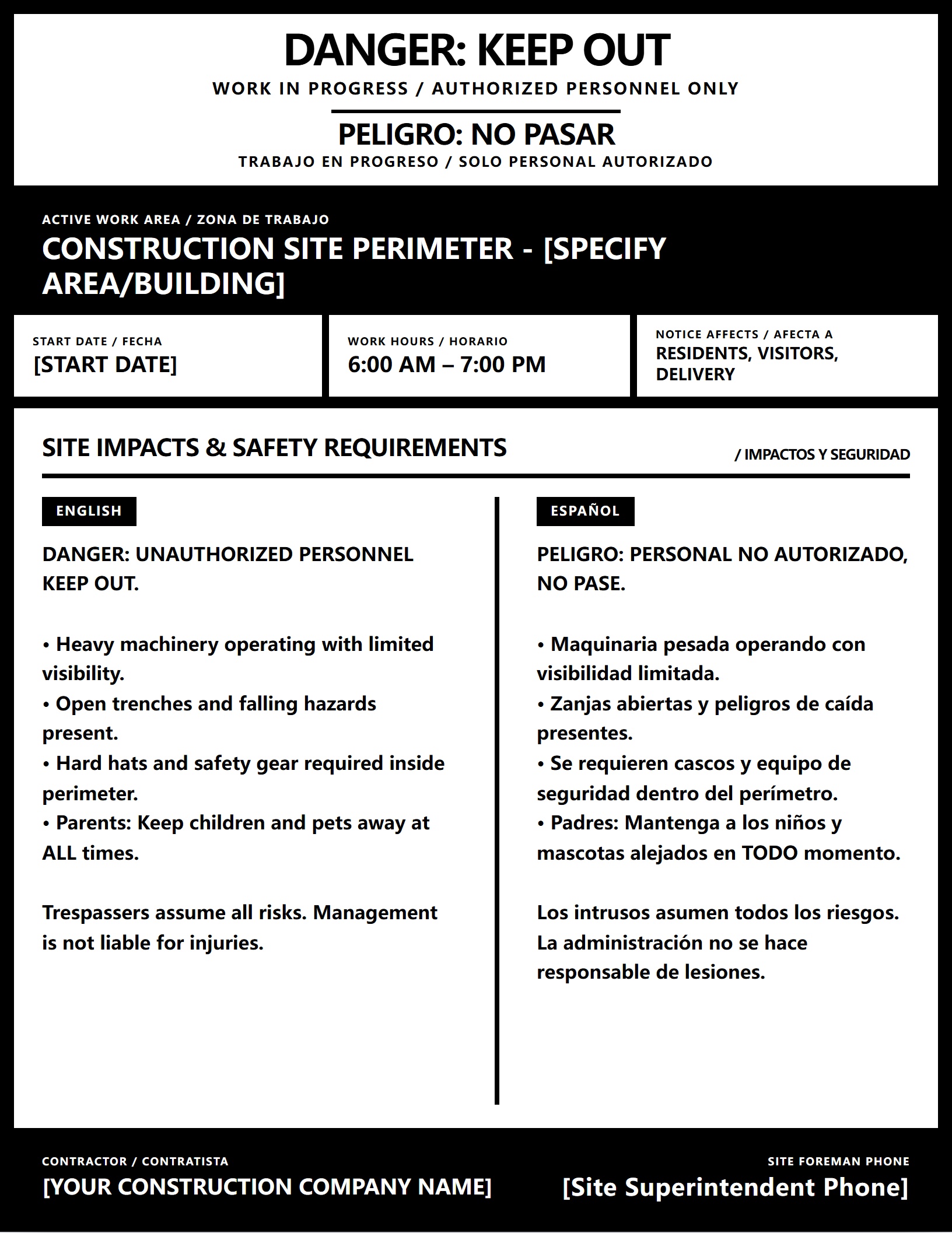
Notice Editor & Preview
Edit Notice
Live Print Preview
US Letter • 8.5" x 11"
Legal Deadline Calculator
Powered by US Office of Personnel Management (OPM) rules.
Send digital alert to property manager and affected tenants
Mandatory Adjustment Applied
Deadline fell on a non-business day (Weekend Exclusion (Sat/Sun)). Automatically pushed back to ensure compliance with Civil Code standards.
Erect continuous physical fencing or heavy-duty barricades
Compliance & Legal Disclaimer: Calculations are strictly based on U.S. Office of Personnel Management (OPM) observed federal holiday rules and standard weekend exclusions. While this tool is designed for enterprise-grade accuracy regarding FLSA and standard property management protocols (e.g., CA Civil Code §1950.5), local municipal codes may vary. NoticeMint is a workflow software, not a law firm. Always verify critical statutory deadlines with your legal counsel.
Execution Protocol
Operational Timeline & Compliance Checklist
- 72 hours before site mobilization Responsible: contractor
Send digital alert to property manager and affected tenants
💡Pro Strategy
Provide the Property Manager with a site map showing the exact footprint of the Work Zone. Request them to forward this to all tenants, emphasizing that the area is strictly off-limits to pedestrians and pets.
- Day of site mobilization Responsible: contractor
Erect continuous physical fencing or heavy-duty barricades
⚠️Liability Alert
Never rely solely on warning signs without physical barriers. If a child can walk through it, you are liable for "Attractive Nuisance".
💡Pro Strategy
OSHA requires physical barriers for drop-offs and excavations. Caution tape is NOT sufficient for a "Keep Out" zone. Use chain-link fencing, Jersey barriers, or rigid plywood hoarding to physically block access.
- Immediately after barriers are set Responsible: contractor
Mount Work Zone signs at all approach vectors at fence_gates, pedestrian_walkways, equipment_storage
💡Pro Strategy
Mount signs at eye level (approx. 5 feet) every 20 feet along the perimeter, and at every potential entry point. Ensure the bilingual text is clearly visible from the outside of the fence.
- Start of each daily shift (Repeat Daily) Responsible: contractor
Inspect perimeter integrity and sign visibility daily
💡Pro Strategy
Wind, delivery trucks, or vandals may knock down barriers or obscure signs. The Site Superintendent must walk the perimeter every morning before firing up heavy equipment.
- End of daily shift (Repeat Daily) Responsible: contractor
Lock out heavy equipment and secure keys at end of shift
💡Pro Strategy
Never leave keys in the ignition of excavators, skid steers, or loaders. Lower all buckets and blades to the ground. Engage hydraulic lockouts to prevent unauthorized operation or accidental movement.
- Before leaving site for the day Responsible: contractor
Backfill open trenches or install trench plates
💡Pro Strategy
If trenches cannot be backfilled daily, they MUST be covered with engineered steel trench plates, pinned to the ground, and surrounded by barricades. An uncovered trench at night is a fatal OSHA violation.
- After final site clearance and inspection Responsible: contractor AUTOMATABLE
Demobilize Work Zone and remove all signage
💡Pro Strategy
Only remove "Keep Out" signs after all heavy equipment has left the property, all trenches are permanently filled, and the ground is restored to a safe, walkable condition.
Required Posting Locations
Physical Distribution Checklist
- fence_gates
- pedestrian_walkways
- equipment_storage
Liability Defense Rule
Always take a timestamped wide-angle photo of the posted notice in its physical location. If a tenant claims they were not notified, this photo is your primary legal defense.
Operational Guidance
Industry Best Practices & Field-Tested Strategies
Always use rigid physical barriers (chain-link fencing, Jersey barriers, or plywood hoarding) for "Keep Out" zones. OSHA strictly prohibits relying solely on plastic caution tape to prevent access to excavations, drop-offs, or heavy equipment staging areas.
Implement a strict "Keys-Out, Buckets-Down" policy at the end of every shift. Lower all excavator buckets and skid-steer blades to the ground, engage hydraulic lockouts, and remove the ignition keys to prevent unauthorized operation or accidental movement.
Cover all open trenches that cannot be backfilled daily with engineered steel trench plates. These plates must be pinned or secured to the ground to prevent shifting, and the perimeter must be surrounded by hard barricades and illuminated at night.
Conduct a mandatory daily perimeter walk at the start of every shift. The Site Superintendent must verify that wind, delivery trucks, or vandals have not compromised the fencing, obscured the bilingual warning signs, or created new blind spots.
Mount "Danger: Keep Out" signs at eye level (approx. 5 feet) every 20 feet along the perimeter and at every potential entry point. Bilingual (English/Spanish) signage is legally critical to ensure comprehension by all site workers, tenants, and neighboring pedestrians.
Manager Checklist
- Review and approve the contractor's Site Logistics Plan, specifically verifying the footprint of the Work Zone, dumpster placement, and pedestrian rerouting paths.
- Verify the contractor's General Liability insurance and ensure the property is listed as an Additional Insured. Confirm coverage specifically includes "Attractive Nuisance" and third-party bodily injury.
- Distribute a digital "Work Zone Alert" map to all tenants 72 hours before mobilization, explicitly stating that the fenced area is strictly off-limits to pedestrians, children, and pets.
- Conduct a Day 1 site walkthrough with the Site Superintendent to verify that hard physical barriers (not just tape) are fully erected and bilingual "Danger: Keep Out" signs are posted at all entry points.
- Monitor the site daily to ensure that heavy equipment keys are removed at the end of the shift and open trenches are properly covered with secured steel plates.
- Immediately report any compromised fencing, missing signs, or tenant complaints about construction debris encroaching on walkways to the contractor's safety officer.
- Retain all daily perimeter inspection logs, signed delivery receipts for tenant alerts, and site photos in the property compliance file for liability defense.
Common Costly Mistakes
- ✗ Using yellow "Caution" tape instead of red "Danger" tape or hard fencing. Caution tape is only for minor trip hazards. Using it to block access to a fatal hazard (like an open trench or heavy machinery zone) is an immediate OSHA citable offense.
- ✗ Failing to account for the "Attractive Nuisance" doctrine. If a construction site features elements that naturally attract children (like piles of dirt, heavy machinery, or open pipes), the contractor and property owner are fully liable for injuries to trespassing children unless robust physical barriers are in place.
- ✗ Leaving heavy equipment running or unattended with keys in the ignition during lunch breaks. It takes less than 30 seconds for an unauthorized person or a curious teenager to climb into a cab and trigger a fatal hydraulic movement.
- ✗ Placing "Keep Out" signs only on the main gate. Pedestrians and children will easily bypass the main entrance by walking through gaps in the landscaping or climbing over low retaining walls. Signs and barriers must cover ALL approach vectors.
- ✗ Ignoring heavy equipment blind spots (the "Swing Radius"). Workers and pedestrians often assume the operator can see them. The exclusion zone must extend beyond the machine's maximum swing radius and tail swing, not just the immediate digging area.
Resident Preparation Checklist
Include this checklist in your notice to reduce tenant calls by up to 60%
- ☐ Treat all fenced or barricaded areas as strictly off-limits. NEVER cross red danger tape or climb over construction fencing, even if you do not see active work.
- ☐ Keep children and pets on a short leash and strictly away from the construction perimeter. Heavy machinery operators have massive blind spots and cannot see small children or pets.
- ☐ Follow all posted pedestrian detour signs. Do not attempt to take "shortcuts" through the work zone, as the ground may be unstable or contain hidden tripping hazards.
- ☐ Keep your apartment windows closed if the work zone is directly below or adjacent to your unit to prevent dust, debris, and loud equipment noise from entering.
- ☐ Report any damaged fencing, missing warning signs, or unlocked gates to the property management office IMMEDIATELY. Do not attempt to fix or secure the barrier yourself.
- ☐ Be aware of increased heavy truck traffic during material delivery hours. Yield to construction vehicles in parking lots and driveways, as their braking distance and visibility are severely limited.
Frequently Asked Questions
What is the "Attractive Nuisance" doctrine in construction site liability?
Does OSHA allow plastic caution tape to secure a construction "Keep Out" zone?
What are the OSHA requirements for securing open trenches overnight?
If a trespasser is injured in a clearly marked "Keep Out" construction zone, is the contractor liable?
Disclaimer
- • OSHA 29 CFR 1926 Subpart P (Excavations) and Subpart O (Motor Vehicles, Mechanized Equipment, and Marine Operations) strictly govern the physical security of construction zones. This template provides operational guidance and does not replace a certified Site Safety and Health Plan (SSHP).
- • The "Attractive Nuisance" doctrine is governed by state tort law and varies significantly by jurisdiction. Always consult your local property attorney and insurance broker regarding specific fencing and signage requirements.
- • Bilingual signage (English/Spanish) is strongly recommended by OSHA and often mandated by local municipal codes to ensure that safety warnings are comprehensible to all workers, tenants, and neighboring pedestrians.
- • Contractors must maintain a daily log of perimeter inspections, equipment lockout verifications, and trench cover checks. These logs are the first documents requested by OSHA inspectors following a site incident.
- • Always retain copies of all tenant notifications, site logistics maps, and daily safety logs for a minimum of 5 years, or as required by your state's statute of repose for construction-related liability claims.
Related Operational Tasks
Complete your communication workflow with these related notices